Most contractor websites answer one question: are you real? The best ones answer a different one: are you the one?
When contractors built their first websites, a Google Maps pin and a phone number was the whole game. That era is over. Below we unpack the four questions every homeowner is silently asking when they land on your website today.
It’s 11pm and Someone Just Left Your Website
Somewhere right now, a homeowner is on their phone researching exterior contractors in your area. It’s late, and they’re not ready to talk to anyone.
They land on your website. They see a logo, a phone number, a list of services, and three photos from a job you did in 2021. They spend eleven seconds on the page and hit the back button.
They didn’t leave because your work is bad. They left because your website didn’t give them a reason to stay. It didn’t answer the questions they were actually asking.
Gone are the days where a contractor website only needed to answer one question:”Are you real?”
Today’s homeowner is asking 4 questions before they ever pick up the phone:
- Have you done this before?
- Can I picture this on my own home?
- Do other people trust you?
- How do I take the next step?
The contractor whose website answers all four gets the call in the morning. This article breaks down exactly how.
Have you done this before?
A homeowner who finds you online wants to see the work. Not stock photography. Not a hero image from a manufacturer’s catalogue. Real jobs, recent ones, on houses that look like theirs.
The problem is that most contractor websites have a gallery that was last updated when the site was built. Keeping it current meant coordinating with a web designer, organizing photos from three different phones, and finding time between jobs to make it happen. So it didn’t happen.
That era of website maintenance is over.
The best contractor websites today have a living portfolio — one that grows automatically with every completed job, without anyone touching the website. The work documents itself. The homeowner browsing at 11pm sees a current record of what your company has built recently, not a snapshot from three years ago.
The tool most responsible for making this possible in the exterior remodeling industry is CompanyCam. Every photo your crew takes on a job site is automatically time-stamped, GPS-tagged, and organized by project. The portfolio builds itself while your crew focuses on the work.
This is automation done well — not a tool that creates more work, but a system that produces an asset without asking anything extra from your team.
Can I Picture This On My Own Home?
This is the question most contractor websites never answer. And it’s the most important one.
A homeowner considering a full exterior renovation is trying to make a $30,000 decision about something they’ve never seen before. They’re staring at a photo of someone else’s house, trying to transpose it onto their own. They’re squinting at a color swatch trying to imagine it at scale. They’re being asked to commit serious money to something that exists entirely in their imagination.
Most people, when asked to imagine something they can’t see, hesitate. Hesitation becomes a second opinion. A second opinion becomes a lost job.
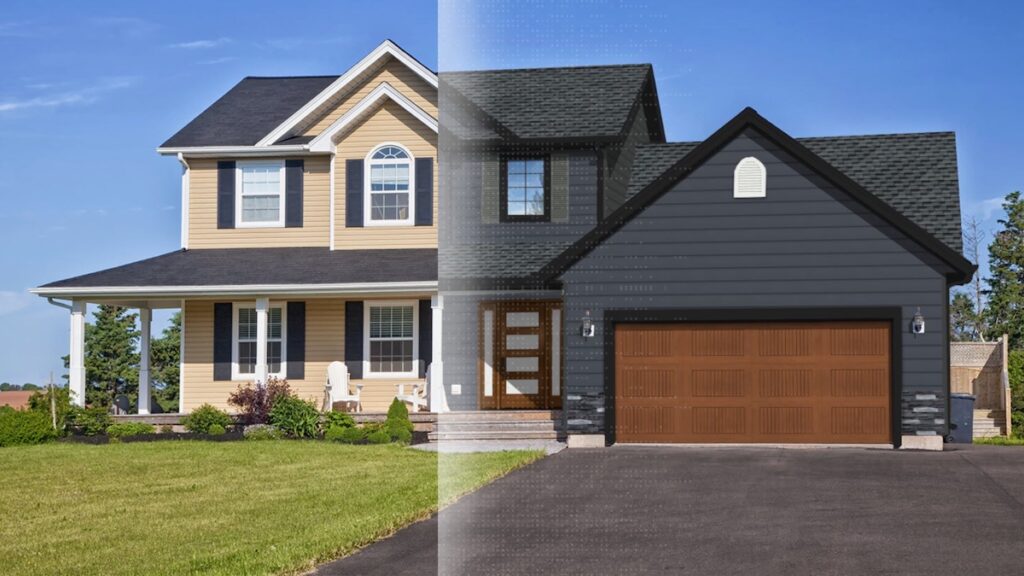
The contractors who’ve solved this don’t ask homeowners to imagine anything. They show them. A photo of the actual house, with real manufacturer materials applied to it, rendered realistically enough that the decision stops feeling abstract and starts feeling inevitable.
That’s what a visualization tool does on a contractor website — and it’s the single biggest gap between a website that converts and one that collects traffic without doing anything with it. Renoworks Pro lets contractors embed a live visualizer directly on their website, so a homeowner can upload a photo of their own home and start exploring finishes, colors, and materials before they’ve spoken to anyone. By the time they fill out a contact form, they’ve already made an emotional decision.
The close doesn’t start at the estimate. For the best exterior contractors, it starts on the website.
Do Other People Trust You?
There’s a moment in every homeowner’s research process where they stop looking at what you say about yourself and start looking at what other people say about you. It happens quickly, and it’s decisive.
Most contractor websites handle this badly. A testimonials page with four quotes, no dates, no photos, no way to verify any of it. Or a Google review badge buried in the footer that hasn’t moved past 23 reviews in two years. Neither of those things closes anyone.
The homeowner doing serious research wants to see volume, recency, and specificity. Not four glowing paragraphs that read like the contractor wrote them.
The gap between those two things isn’t effort — it’s system. Most contractors do good work and earn good reviews. They just never ask. And when they do ask, it’s a text message sent three weeks after the job ended when the homeowner has already moved on emotionally.
NiceJob closes that gap. It automates the review request at the moment the job ends — when the homeowner is most satisfied, most likely to respond, and most able to describe the work in specific detail. Those reviews feed directly onto the website, keeping the social proof current without anyone managing it manually.
A contractor with 200 recent reviews isn’t just credible. They’re the obvious choice.
How Do I Take The Next Step?
Let’s say everything worked.
The homeowner found your website, saw recent work that looked like their house, visualized the finished result, and read through forty reviews from people in their neighbourhood. They’re ready.
And then they hit a contact form that says “we’ll get back to you within 24-48 hours.”
That’s the moment the decision unravels. Not dramatically — they don’t close the tab in frustration. They just get tired. They open another tab. They find someone else whose website lets them book a consultation for Thursday at 10am right now, without waiting for a callback that may or may not come before their attention moves on.
The best contractor websites remove friction entirely. They don’t ask the homeowner to wait — they give them a way to commit at the exact moment they’re ready to commit, which is often late at night when nobody is answering phones.
Calendly is the simplest version of this fix. A booking tool embedded directly on the website that lets a homeowner schedule a consultation in under a minute — no phone tag, no follow-up email, no waiting. The contractor wakes up to a booked appointment they didn’t have to chase.
It sounds like a small thing. It isn’t. Every extra step between intent and action loses people. Removing the last barrier between a motivated homeowner and your calendar is the quietest competitive advantage on this list.
The homeowner who can book at 11pm will. The one who has to wait until morning sometimes won’t.
The Big Takeaway
Go back to that homeowner from the intro. It’s late. They’re researching. They land on your website.
This time it’s different:
- They see a portfolio of jobs completed last month, on houses that look like theirs.
- They upload a photo of their own home and spend twenty minutes trying different siding colors.
- They read through dozens of recent reviews from people two streets over.
- They book a consultation for Thursday morning without talking to anyone.
By the time you wake up, the job is half sold.
That’s what a working contractor website does. Not because it’s flashy or expensive to build — but because it was designed around the four questions every homeowner is actually asking:
Have you done this before? — Yes. Here’s thirty recent projects.
Can I picture this on my own home? — Yes. Here’s the visualizer.
Do other people trust you? — Yes. Here’s two hundred reviews from the last year.
How do I take the next step? — Here’s Thursday at 10am.
The gap between the contractor chasing bids and the one turning away work isn’t always skill. It isn’t always price. More often than it should be, it’s a website that was built to prove the business exists rather than to grow it.
That’s a fixable problem. And now you know exactly where to start.
Stop competing on price.
Win on trust.
Original research from 20 top contractors on how they hold their price, earn a homeowner’s trust, and still get picked.
Check out the playbook →
Related Articles
More on the tools, tactics, and platforms exterior contractors use to sell more work and close faster.
 Digital Marketing for Contractors: 2025 Playbook to Generate Leads and Grow Construction Companies
Read More »
Digital Marketing for Contractors: 2025 Playbook to Generate Leads and Grow Construction Companies
Read More »
 The Stack That Separates a $5M Contractor from Someone Chasing Bids
Read More »
The Stack That Separates a $5M Contractor from Someone Chasing Bids
Read More »
 The 8 Best CRMs for Contractors and Construction Businesses
Read More »
The 8 Best CRMs for Contractors and Construction Businesses
Read More »
 What Is Home Visualization Software?
Read More »
What Is Home Visualization Software?
Read More »