The short version
- AI is an assistant, not a replacement. Use it to remove repetitive work and give your team better information faster, not to replace inspection, sales, or installation.
- It can help across the whole workflow: lead intake, roof measurements, damage detection, estimates, follow-up, and homeowner visualization.
- The best return comes from targeting your biggest bottleneck (missed calls, slow estimates, manual data entry), not from buying the most tools.
- Aerial measurement and AI damage detection speed up prep, but a qualified pro still verifies the roof.
- For homeowner decisions, pair AI inspiration with product-specific visualization so homeowners see real, buyable roofing products on their own home.
Artificial intelligence is changing how roofing companies handle everything from the first inbound call to the final proposal.
Today, a roofer can use AI to answer a customer inquiry after hours, qualify a lead, schedule an inspection, analyze aerial imagery, help measure a roof, generate an estimate, organize job information, and automate follow-up.
But there is an important distinction between using AI to support a roofing business and trying to make the entire business run on AI.
The best roofing AI applications don’t replace the people who inspect roofs, sell projects, manage crews, or install shingles. They remove repetitive work and give those people better information, faster.
For roofing contractors considering AI, that’s the key question: Where can artificial intelligence technology actually make your roofing operation faster, more responsive, and more profitable?

What Is an AI Roofing Company?
An “AI roofing company” can mean two different things.
The first is a roof company that uses AI-powered technology throughout its sales, inspection, estimating, and operations workflows.
The second is a technology company that builds AI applications specifically for roofing companies.
An AI tool might handle a single task, such as generating a roof measurement, or it might connect several parts of the workflow. Some platforms use AI to answer calls and qualify leads, while others analyze aerial or satellite imagery to help contractors understand a property’s roof.
The important thing to remember is that AI is an assistant, not a replacement for roofing expertise.
For example, an AI application can analyze an image and identify characteristics that may be relevant to a roof inspection. It can help calculate measurements or generate a preliminary estimate. But a qualified professional still needs to assess the property and verify information before making decisions about the roofing job.
The same principle applies to sales.
AI can help a sales rep prepare information, follow up with a homeowner, or generate a proposal. It can’t replace the trust, judgment, and communication that often determine whether a homeowner chooses your roof company.
Why Are Roofers Adopting AI?
Roofing is particularly well suited to AI because so much of the business involves repetitive information and time-sensitive communication.
A storm can generate hundreds of inquiries in a short period of time. Homeowners dealing with hail or storm damage aren’t necessarily going to wait two days for a callback. They may contact several roofing contractors and schedule the first inspection available.
That makes response speed a competitive advantage.
AI can help a roofing company provide coverage when employees aren’t available. An AI chatbot or voice agent can answer an inbound call, collect information, qualify the lead, and schedule an appointment.
It can also help automate follow-up so leads don’t disappear simply because a salesperson got busy.
Other reasons contractors are exploring AI include:
- Missed calls and unanswered inquiries
- Repetitive administrative work
- Slow estimate turnaround
- Manual data entry
- Disconnected CRM information
- Scheduling challenges
- Homeowner communication
- Increasing labor costs
- Storm-related spikes in demand
- The need to respond to leads outside normal business hours
The goal isn’t to use AI because it’s the latest technology.
The goal is to use AI where it gives your team leverage.
How Roofing AI Is Used
There are dozens of possible AI applications in roofing. The most useful way to evaluate them is by looking at where they fit into your existing workflow.
1. Lead Intake and Customer Service
The first opportunity may be sitting right at the beginning of your sales cycle.
When a homeowner calls about a roof leak, missing shingles, hail damage, or a possible replacement, an AI-powered system can answer the inquiry immediately.
AI chatbots and voice agents can collect basic information, ask qualifying questions, refer urgent situations to the appropriate person, and schedule an inspection.
Instead of sending an inbound call to voicemail, your company can capture the opportunity while the homeowner is actively looking for help.
AI can also assist with lead generation and customer acquisition by helping create marketing content, respond to website inquiries, and organize information about prospective customers.
For a growing roof company, the ability to capture more of the demand you’re already generating can be more valuable than simply generating more leads.
2. Roof Measurements and Aerial Imagery
One of the most established applications of AI in roofing is analyzing aerial imagery.
Instead of sending a salesperson to every property simply to gather basic measurements, roofing software can use satellite imagery, aerial photography, and other property data to help determine roof dimensions.
Some platforms can identify roof planes, calculate square footage, estimate pitch, and provide other information that can help a contractor prepare for a site visit.
Companies such as EagleView and Nearmap have built tools around aerial imagery and property intelligence, while platforms such as Roofr incorporate roof measurement into broader roofing workflows.
This doesn’t eliminate the need to inspect a roof.
It can, however, reduce guesswork and help a contractor arrive at the site with more information.
For example, a roof measurement can help a sales rep prepare an estimate before the appointment. Aerial imagery can provide a high-resolution view of the property before someone physically climbs a ladder.
The important distinction is between using AI to prepare for an inspection and using AI instead of an inspection.
AI can help you measure a roof. It doesn’t eliminate the professional judgment required to determine its actual condition.

3. Roof Inspection and Damage Detection
AI is also being used to analyze images for potential roof damage.
Computer vision algorithms can analyze images and identify patterns associated with damaged or aging materials. Depending on the system and imagery available, AI may help flag missing shingles, potential hail damage, wear and tear, or other conditions that warrant closer attention.
Drone inspections can provide another source of high-resolution images for this type of analysis.
A drone can capture detailed images without requiring a worker to physically climb onto every roof, while AI can help organize or analyze those images.
But again, the output should be treated as an assessment aid, not an automatic verdict.
Weather, lighting, image quality, roof material, and other factors can affect what an AI system sees. A contractor should still inspect the roof and verify important findings.

4. Estimates and Proposals
AI can also shorten the path from inspection to estimate.
Once measurements, material information, and project details have been collected, software can help calculate quantities, organize costs, generate estimates, and create proposals.
For roofing companies, this can reduce the amount of manual work required between the site visit and the homeowner’s proposal.
It can also help standardize the sales process.
Instead of every salesperson creating a quote differently, your company can establish a consistent workflow for turning project information into a professional proposal.
Tools such as SumoQuote, Roofr, and JobNimbus are examples of platforms contractors may evaluate when looking at estimating, proposals, CRM, and project management.
The goal isn’t simply to generate an estimate instantly.
It’s to make sure the estimate is accurate, consistent, and delivered while the homeowner is still engaged in the sales process.
5. Follow-Up and CRM Automation
One of the easiest places to use AI is after the initial conversation.
Salespeople are busy. They are driving between appointments, meeting homeowners, answering questions, and working with crews and office staff.
That makes follow-up one of the first things to get pushed aside.
AI can help automate reminders, organize customer information, record conversations, draft follow-up messages, and update a CRM.
For companies using JobNimbus or another CRM, AI-assisted workflows can help reduce the amount of manual information that sales reps and office employees need to enter.
This matters because a missed follow-up isn’t just an administrative mistake.
It can mean losing a roofing job you already paid to generate.
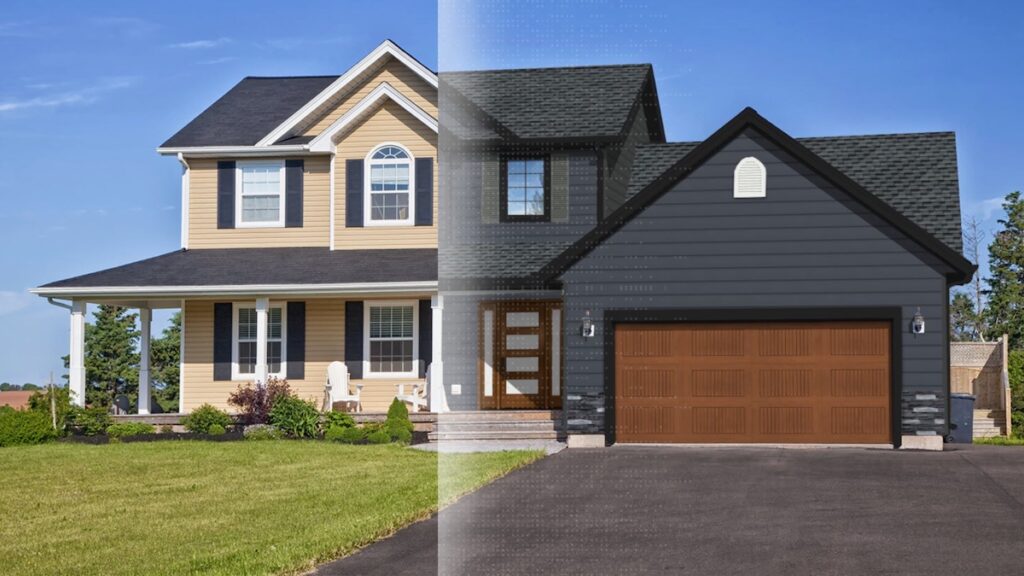
6. Homeowner Design and Visualization
AI can also play a role in the homeowner’s decision-making process.
Replacing a roof is a significant purchase. Homeowners aren’t always sure which shingle, color, or material type will look best on their house.
An AI tool can generate design ideas or help a homeowner explore different possibilities.
That’s useful, but there’s an important limitation.
General-purpose AI can generate an attractive image without necessarily representing a real product that a contractor can install.
For roofing contractors, the most useful approach is to combine AI-powered inspiration with product-specific visualization.
With a platform such as Renoworks, contractors can show homeowners how actual roofing products and colors could look on their own home.
That moves the conversation beyond “AI generated this cool roof.”
Instead, the homeowner can explore a design and connect that design to real products they can actually purchase and install.
For a sales rep, that can make the proposal more visual and help eliminate some of the uncertainty that slows down the sales cycle.

Win on trust.
Twenty top contractors on how they hold their price against a cheaper bid, and still win the job.
Check out the playbook →
Best AI Tools for Roofing Companies
There is no single AI tool that is automatically the best choice for every roofing contractor.
Instead, think about building an AI stack around the areas where your company has the biggest bottlenecks.
| Roofing workflow | Tools to consider | Potential use |
|---|---|---|
| Roof measurement | EagleView, Roofr | Aerial measurements and property information |
| Aerial imagery | Nearmap, EagleView | High-resolution property imagery and analysis |
| Documentation | CompanyCam | Photos, reports and job documentation |
| Estimates and proposals | SumoQuote, Roofr | Estimates, quotes and proposals |
| CRM and operations | JobNimbus, Roofr | Lead management, scheduling and project workflows |
| Voice and communication | Whippy | AI-assisted calls, lead qualification and scheduling |
| Roof visualization | Renoworks | AI-assisted design and visualization using real products |
The right tool depends on the problem you’re trying to solve.
If your biggest problem is missed calls, an AI voice system may have the highest impact.
If your sales team spends hours measuring properties, look at aerial measurement technology.
If homeowners routinely struggle to choose a shingle, visualization may have a bigger impact on your close rate.
And if your team is drowning in administrative work, CRM automation and AI-assisted workflows may be the better place to start.
How Much Does Roofing AI Cost?
The cost of roofing AI varies significantly depending on the application.
Some tools have free trials or entry-level subscriptions. Others charge per user, per project, per measurement, or per report. More sophisticated systems may involve additional costs for integrations, implementation, training, or custom workflows.
For example, Roofr offers subscription plans as well as separately priced measurement reports. Other platforms use different pricing structures based on users, projects, imagery, or features.
That makes comparing monthly subscription prices alone misleading.
Instead, calculate the potential return.
Start with questions such as:
- How many leads are currently lost because nobody answers an inbound call?
- How long does it take to produce an estimate?
- How many site visits could be reduced or made more productive?
- How much time does your office spend on manual data entry?
- How many hours are spent creating proposals?
- How much follow-up is currently being missed?
- How often do homeowners stall because they can’t visualize the finished project?
- Could faster response help your sales team book more inspections?
Then compare those costs with the price of the technology.
For example, suppose an AI tool saves a sales rep five hours per week. That’s not just a technology benefit. Those five hours could be spent on additional appointments, customer communication, or closing more roofing jobs.
The best AI investment is rarely the one with the most features.
It’s the one that solves an expensive problem.
Questions Roofers Ask About AI
Is AI accurate enough for roofing?
AI can be extremely useful, but accuracy depends on the application, data, imagery, and conditions.
A roof measurement generated from aerial imagery may provide an excellent starting point. An AI damage detection system may identify areas that deserve closer inspection.
Neither should automatically override professional judgment.
Use AI to gather information and identify patterns. Have qualified people verify information that affects the scope, price, safety, insurance claim, or installation.
Can AI inspect a roof without a roofer?
AI can assist with roof inspections, but it doesn’t replace a professional inspection.
Aerial imagery, drone images, and AI analysis can help identify potential problems before or during an inspection.
A roofer still needs to determine what those findings actually mean.
Can AI replace roofing sales reps?
AI can automate parts of a sales process, but it doesn’t replace the human relationship.
A chatbot can answer a question. A voice agent can schedule an appointment. An AI system can generate a proposal.
But homeowners still want confidence that the contractor understands their problem and will do the job correctly.
The strongest approach is usually to let AI handle repetitive tasks while your sales team focuses on conversations that require judgment and trust.
Can I use ChatGPT, Claude, or Gemini for my roofing business?
Yes.
General-purpose AI tools such as ChatGPT, Claude, and Gemini can help with content creation, marketing ideas, customer communication, process documentation, sales scripts, and other everyday business tasks.
But general AI has a different role from specialized roofing software.
You can ask ChatGPT to help write a follow-up email. You wouldn’t necessarily use it to determine the final roof measurement for an insurance claim.
You can ask an AI model for ideas about shingle colors. You wouldn’t want to assume the generated image represents the exact product available from your supplier.
Know what the tool is designed to do.
Should roofing companies use AI for insurance claims?
AI can help organize documentation, measurements, images, and other information associated with an insurance claim.
But insurance claims require careful review.
Contractors should verify information before submitting it and should follow applicable requirements from insurers, adjusters, local authorities, and other parties involved in the claim.
Don’t let an AI-generated assessment become a substitute for professional verification.
Is roofing AI secure?
Before putting customer information into any AI system, understand how the platform handles your data.
Look at its privacy policies, security practices, data retention, integrations, and user permissions.
Be particularly careful with sensitive financial information, insurance documentation, personal information, and confidential customer communications.
Convenience shouldn’t come at the expense of security.
The Bottom Line: Use AI Where It Gives Your Team Leverage
The roofing companies that get the most value from AI won’t necessarily be the companies using the most technology.
They’ll be the companies using it in the right places.
AI can answer the phone when your team can’t. It can capture an inquiry, qualify a lead, schedule an inspection, analyze aerial imagery, help measure a roof, organize photos, generate a proposal, automate follow-up, and help homeowners explore design options.
But your people still matter.
Your inspector verifies the roof. Your sales rep builds the relationship. Your project manager coordinates the job. Your crew installs the shingles. Your company stands behind the work.
That’s the real opportunity with roofing AI.
Don’t use artificial intelligence to replace the parts of your business that make you valuable. Use it to remove the work that gets in the way of them.
When AI handles repetitive tasks and your team handles the expertise, you can respond faster, streamline operations, improve the homeowner experience, and create more opportunities to win profitable roofing jobs.
Use the Renoworks Roof Designer to turn “I can’t picture it” into a signed proposal.
Try the Roof Designer →